

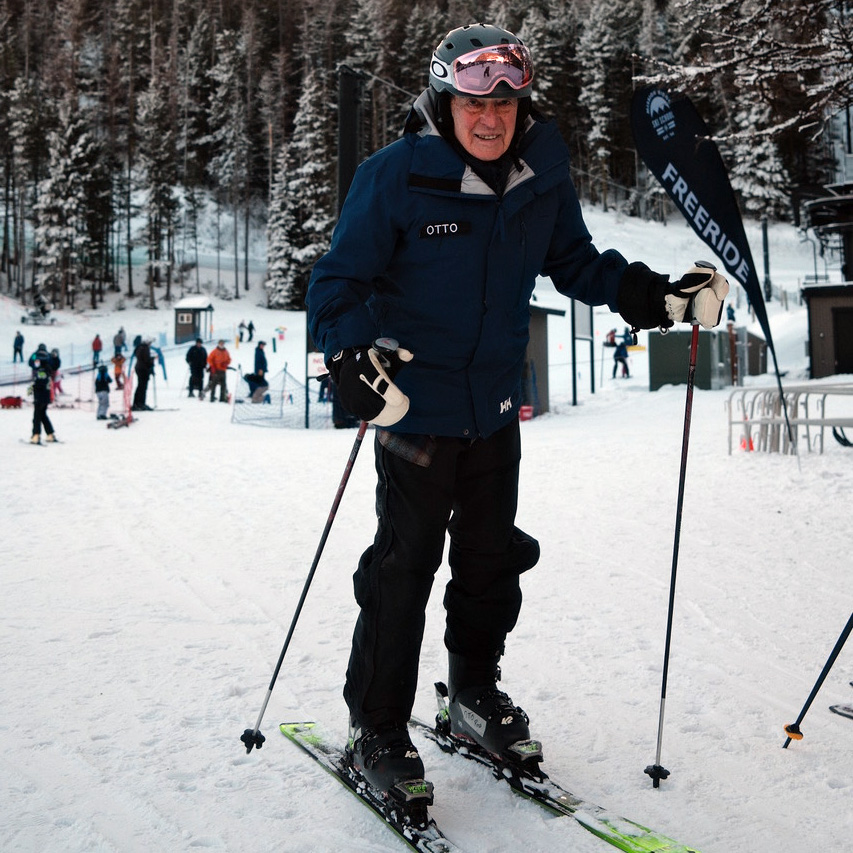
Otto Ross has spent nearly a century proving that skiing is not simply a sport, but a way of life. Born in Wenatchee, Washington on January 27, 1926, Otto grew up in nearby Orondo, where life revolved around family, work, and the outdoors. From an early age, movement and nature were constants. His first skis were pine boards ordered from the Montgomery Ward catalog, fitted with leather toe straps and inner-tube bindings. He skied in orchards and on small hills near his home, learning balance and perseverance long before formal instruction entered his life.¹
Otto’s early skiing took shape at Badger Mountain in Waterville, where his father drove him and his friends to ski the rope tows. As a teenager, he and three friends regularly traveled to Stevens Pass whenever they could gather enough money for gas. “We’d watch people and follow the best skier we could find to get better,” Otto once said. That instinct to observe, learn, and improve through example would guide him throughout his life as both a skier and an instructor.²
After graduating from Wenatchee High School in 1944, Otto served in the U.S. Navy, leaving active duty in 1946. He earned a degree in Agricultural Science from Washington State College, now Washington State University, and returned to Orondo to work in his father’s orchard. When his father passed away, Otto took over the operation, eventually managing large fruit orchards in Orondo and Quincy that produced apples, peaches, and pears. Even while farming full time, skiing remained his defining passion.³
Otto taught his first ski lessons in 1950 at KPQ Ski School at Squilchuck, before it became a state park. He passed his National Ski Patrol test in 1951 at Mount Baker and earned his ski instructor certification at Mount Hood in 1952. Throughout the 1950s, Otto became deeply involved in ski instruction and ski patrol leadership across the Pacific Northwest. He served as president of the Wenatchee Ski Club, chaired the Teacher’s Certification Committee, and represented the region at annual association meetings. He also helped establish ski schools at Ardenvoir, Echo Valley, and Badger Mountain, laying the groundwork for organized instruction across Central Washington.⁴
In 1959, Otto was selected to represent the Pacific Northwest at Squaw Valley to demonstrate that volunteer ski patrols could handle the medical and safety responsibilities required for the upcoming 1960 Winter Olympics. The following year, he served as part of the Olympic ski patrol and honor guard, skiing alongside the Olympic torch during the opening ceremony. While there, he witnessed the United States men’s hockey team win its first Olympic gold medal, a moment he would later recall as unforgettable.⁵
Otto taught skiing full time beginning in 1961, working at Stevens Pass, Whitefish Mountain Resort in Montana, and Alpine Meadows in California. He delighted in proving that instructors from small, local mountains could match the skill and professionalism of those from major resorts. While teaching at Alpine Meadows, he ranked second in total private lessons within two years, outpacing many instructors with far higher profiles.⁶
When Mission Ridge Ski & Board Resort opened in 1966, Otto offered his services and became Assistant Director of the Ski School. From the start, he helped shape the culture of instruction on the mountain. His teaching philosophy was simple and consistent: begin with understanding. Otto would gather students around the trail map before ever stepping onto snow, believing that knowing the mountain was as important as skiing it. From there, lessons progressed methodically, often beginning on the rope tow with the long-term goal of seeing students confidently reach Chair One.⁷
Perhaps Otto’s most enduring legacy is his pioneering work in adaptive skiing. In the mid-1960s, he helped Pat West Turner return to skiing after a car accident resulted in the amputation of her right leg. Adaptive ski equipment was new and largely untested at the time. Otto studied early materials, worked through the challenges alongside his student, and helped Pat relearn the sport she loved. She went on to become a national champion amputee skier and later published her memoir, Skiing Uphill: A Story of Strength and Perseverance. She has credited Otto not only as an instructor, but as a steady and compassionate presence during one of the most difficult periods of her life.⁸
In 1968, Otto was accepted into the French National Ski School in Chamonix, where he completed six weeks of training and earned his certification. He remained in France to teach in Megève, working primarily with English-speaking clients. While the French were widely regarded as superior skiers, Otto later recalled that American instructors often scored higher in teaching, a distinction he carried with pride.⁹
After returning to the United States, Otto continued teaching at Mission Ridge, Alpine Meadows, and Echo Valley, eventually directing ski school operations and mentoring countless instructors. Over the decades, he taught students of every age and ability, from young children to adults well into their senior years. His students included notable figures such as Paul Harvey, Goldie Hawn, and Robert Redford during the filming of Downhill Racer, though Otto never treated fame differently than fear. Beginners remained his specialty.¹⁰
Otto’s legacy at Mission Ridge is permanently etched into the mountain. The Ottobahn Magic Carpet is named in his honor, as is Otto’s Outback, a section of terrain off Chair 4. He has received numerous honors, including induction into the Northwest Skiers Hall of Fame, PSIA Northwest Legend awards, Mission Ridge’s Most Valuable Employee recognition, and Ski School Hall of Fame honors.¹¹
Well into his late 90s, Otto continued teaching regularly. Observers often remarked that his age faded into the background, replaced by the joy and confidence of the students he guided. As one fellow instructor noted, the focus was always on the success and fun his guests were having.¹²
Asked about the secret to his longevity, Otto never cited technique or training regimens. Instead, he spoke about staying active, staying engaged, and always having something to look forward to. He worked his orchard, walked daily, and returned to the mountain season after season. His philosophy is captured in a simple phrase he lives by:
“There is nothing wrong with the struggle.”¹³
At 100 years old, Otto Ross stands as a rare figure in modern skiing: a teacher, a mentor, a pioneer, and a reminder that joy, shared generously, keeps us young.
Endnotes
- Otto W. Ross, Ski History of Otto W. Ross (unpublished personal notes, with corrections, 1931–2022); The Wenatchee World.
- Ross, Ski History of Otto W. Ross; The Wenatchee World.
- Ross, Ski History of Otto W. Ross; family interviews.
- Ross, Ski History of Otto W. Ross; Pacific Northwest Ski Association and PNSIA records.
- Ross, Ski History of Otto W. Ross; National Ski Patrol Olympic history.
- Ross, Ski History of Otto W. Ross; The Wenatchee World.
- Mission Ridge Ski School historical records; The Wenatchee World.
- Ross, Ski History of Otto W. Ross; Pat West Turner, Skiing Uphill: A Story of Strength and Perseverance (2022).
- Ross, Ski History of Otto W. Ross.
- Ross, Ski History of Otto W. Ross; The Wenatchee World.
- Mission Ridge Ski & Board Resort records; PSIA Northwest; Northwest Skiers Hall of Fame.
- Keith Carpenter, Mission Ridge instructor, quoted in The Wenatchee World.
- Otto W. Ross, personal reflections.